

Why Your Guitar Won’t Stay in Tune: The 3 Most Overlooked Culprits (And How a Luthier Fixes Them)
Do you find yourself re-tuning your guitar after every single string bend? Are your open chords completely sour even though your electronic tuner says you are perfectly in pitch?
When a guitar suffers from persistent tuning instability, players usually rush to blame their tuning pegs. However, high-quality tuning machines are rarely the root cause. True tuning stability depends entirely on the mechanical engineering of your guitar’s high-friction contact points.
Here is a technical tear down of the three most overlooked reasons your guitar won’t stay in tune, and the precision adjustments required to fix them permanently.

Guitar Setups begin at the top and go all the way down
What is the primary cause of guitar tuning instability?
The primary cause of guitar tuning instability is friction and binding at the nut slots. When a string binds in a tight or poorly cut slot, it catches during tuning or string bending. This creates unequal tension across the nut, causing the string to return flat or sharp.
1. Nut Slot Binding (The “Ping” of Death)
If you hear a sharp, metallic “ping” sound while tuning up, your strings are physically trapped inside the nut slots.
The Physics of the Bind
When you turn a tuning peg or bend a string, tension must distribute evenly across the entire length of the string—from the ball-end to the post. If a nut slot is cut too narrow or at an incorrect angle, the string gets pinched. Tension builds up behind the nut. When you finally bend a note, the string breaks free, shifting the overall pitch sharp or flat.

Haywire Custom Guitars Keeping your guitar in tune and height of strings at the nut
The Luthier Fix
- Gauge-Matched Files: A luthier uses gauged welding or specialized luthier nut files to widen the slot to exactly 0.002 inches wider than the string gauge.
- The Break Angle: The slot must be filed at a downward slope toward the head stock. This places the absolute witness point at the front edge of the nut facing the fret board.
- Mechanical Lubrication: Applying a dry graphite lubricant or a friction-reducing compound (like self-lubricating TUSQ material) prevents future binding.
2. Incorrect Neck Relief and Truss Rod Slippage
Your guitar neck is under massive physical tension—roughly 150 to 200 pounds depending on your string gauge. If your neck relief changes constantly, your tuning will follow.
The Physics of the Movement
Wood reacts constantly to changes in atmospheric humidity and temperature. If your neck has too much forward bow (relief) or is completely flat, the wood will flex dynamically under the physical stress of heavy playing. Furthermore, if a truss rod is dry or improperly seated, it can micro-slip over time, causing slow pitch drift.
The Luthier Fix
- Measuring Relief: Check the neck relief using a precision straightedge and a feeler gauge at the 7th fret while fretting the 1st and last frets.
- Target Tolerances: For optimal stability and low action, aim for a gap of roughly 0.010 inches on electric guitars.
- Incremental Adjustments: Tighten or loosen the truss rod in strict 1/8-turn increments. Allow the wood fibers time to acclimate to the altered tension distribution.
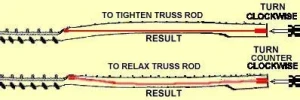
How a guitar truss rod works in the guitar neck.
3. Incorrect Bridge Trajectory and Saddle Friction
Whether you play a hardtail, a vintage-style synchronized tremolo, or a Tune-o-matic bridge, the bridge assembly is a major point of mechanical failure for tuning.
The Physics of the Friction
On a non-tremolo bridge, strings can cut deep, microscopic burrs into the metal saddles over years of playing. These burrs act like teeth, snagging the string wrapper during bends. For tremolo systems, if the bridge plate knife-edges are dull or the pivot posts are nicked, the bridge will fail to return to its exact neutral equilibrium point.
The Luthier Fix
- Saddle Polishing: Use ultra-fine micro-mesh sheets or a fine abrasive cord to polish out any jagged edges or notches inside the saddle string channels.
- Knife-Edge Radiusing: Sharpen worn tremolo pivot points using a micro-file to restore a frictionless single-point pivot connection.
- Spring Balancing: Balance the total mechanical tension of the bridge springs against the exact tension of your specific string set so the bridge floats perfectly level.
Get a Professional 8-Point Shop Tune-Up
Tuning stability is a delicate ecosystem where every millimeter matters. If you have adjusted your gear and your guitar still fails to hold its pitch during live performances, it is time for a professional evaluation.
At Haywire Custom Guitars, we provide deep, microscopic shop adjustments to fix these mechanical issues permanently. From precision nut slot re-cutting to complete neck alignment, we ensure your instrument plays perfectly in tune up and down the entire fret board.

Leave A Comment
You must be logged in to post a comment.