How to Choose the Right Guitar Necks for Big Hands
Guitar necks for big hands? It is one of the most frustrating, unspoken barriers in the guitar world. You sit down to play a complex chord melody or a fast blues run, only to hear a dull, muffled thud instead of a ringing note. For players blessed with larger hands, wide fingers, or broad fingertips, standard factory instruments often feel less like tools of expression and more like tight geometric traps.
“Standard” electric guitars—featuring typical 25.5″ scale lengths and narrow 1.687″ (42.8mm) nut widths—are historically scaled for average or smaller hands. When you force a large hand to compress into that cramped framework, you aren’t just fighting your technique; you are fighting the physical limits of the wood itself. The result? Constant frustration, persistent wrist strain, and a nagging sense that your playing isn’t as clean as it should be.
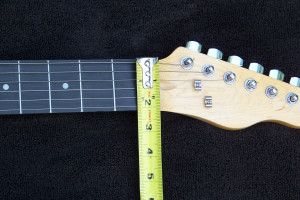
Get extra wide guitar necks at Haywire Custom Guitars custom shop
Why Standard Electric Guitar Wide Nut Widths Feel Too Cramped
The root of the issue comes down to a fundamental measurement: nut width. The nut regulates how close the strings sit next to one another as they travel down toward the headstock. When a nut width is narrow, the strings are squeezed tightly together, leaving virtually zero margin for error between frets.
If your hands are on the larger side, this cramped layout forces your fingertips to pull double duty, often bleeding over into adjacent paths. Instead of focusing entirely on your musicality and dynamics, your hand spends all its energy executing micro-adjustments just to keep from deadening the surrounding notes.
Telltale Signs: How to Stop Accidentally Muting Guitar Strings
How do you know if your factory instrument’s geometry is actively working against your anatomy? Pay close attention to how your hand behaves during a standard set:
- The Open Chord Crunch: When playing basic open shapes like a clean A major or an open C, your fingertips constantly brush against neighbouring strings, choking out the resonance.
- The Squeeze Fatigue: You find yourself excessively squeezing the back of the neck with your thumb just to force your fingers into a perfectly vertical alignment, causing rapid hand cramping and wrist fatigue.
- The Solo Slip: During fast fretboard navigation or precise bends, your fingers feel physically crowded, causing you to accidentally dampen strings that need to ring out clear.
Recognizing these signs is the first step toward reclaiming your playing comfort. You don’t have to change your technique to compensate for a poorly fitted tool. By matching your guitar’s neck geometry to your actual physical dimensions, you can eliminate accidental string muting entirely and let your playing flow naturally.
Choosing Your Target Dimensions: From 1-3/4″ to 2″ Nut Width Electric Guitars
When transitioning away from a cramped fretboard, the goal is to expand your string spacing safely without losing control of the neck profile. Choosing your new nut width is entirely a matter of matching your unique hand size, finger thickness, and playing style to the correct structural dimension.
Rather than sticking to a generic layout, upgrading your instrument allows you to step into a tier of tailored spacing. Let’s break down the three primary wide-nut options to see which width best handles your physical needs.
1-3/4″ Nut Width: The Subtle Transition
The 1-3/4″ (44.4mm) nut width is the ideal gateway choice for players who want a bit more breathing room but still want the neck to feel distinctly like a classic electric guitar.
- Who it’s for: Musicians who find standard necks just slightly too narrow, or electric players who love the natural, familiar spacing of a standard acoustic guitar fretboard.
- The playing experience: This width offers immediate relief for basic open chord fingering without requiring you to stretch or adjust your thumb placement. It provides just enough separation to prevent broad fingertips from overlapping the adjacent strings during fast rhythm tracking or classic rock bends.
Finding the Sweet Spot with a 1-7/8″ Nut Width Electric Guitar Neck
The 1-7/8″ (48mm) nut width is a highly sought-after sweet spot for serious players who struggle with profound string crowding. It is a physical game-changer for thick hands.
- Who it’s for: Guitarists with broad fingertips, thick hands, or classical crossover musicians who are accustomed to wide flat-fingerboard layouts and feel suffocated by standard thin factory necks.
- The playing experience: A 1-7/8″ neck radically changes how your fingers interact with the fretboard. It offers ample string clearance, allowing you to drop complex jazz voicings, barre chords, and intricate fingerstyle patterns with absolute tracking precision. Accidental dampening is virtually eliminated because your fingertips finally have the physical space to arch properly between frets. [1]
2″ Nut Width Electric Guitars: Maximum Spacing for Big Hands
For the ultimate layout expansion, a full 2″ (50.8mm) nut width offers the absolute maximum boundary width available for an electric instrument.
- Who it’s for: Players with exceptionally large hands, long fingers, or those who face severe hand fatigue from trying to cram their fingers into traditional layouts.
- The playing experience: A 2″ width completely opens up the instrument. It mirrors the spacious geometry of a traditional classical guitar while retaining all the hot electronics, sustain, and bending capabilities of a high-performance electric weapon. Every string sits inside its own clean pocket of real estate, letting you play heavy, complex chord variations effortlessly for multi-hour sets without your fingers colliding.
Realizing Guitar Neck Ergonomic Relief and Preventing Hand Cramping
Many guitarists mistake hand fatigue, wrist soreness, and finger stiffness for a lack of practice or poor technique. However, if your body is structurally sound but you are still experiencing pain, the culprit is almost always a severe mismatch between your physical anatomy and your guitar neck’s geometry.
When you spend a long gig squeezing a neck that is too small for your hands, your muscles are forced into an unnatural, continuous state of tension. Realizing true ergonomic relief requires adapting the tool to the player, rather than forcing the player to fight the tool. [
1]
The Anatomy of the Squeeze: What Causes Hand Cramping?
Hand cramping occurs when the small stabilizing muscles in your palm and thumb over-exert themselves to maintain a tight grip. On a narrow factory fretboard, a player with large hands must excessively arch their fingers and squeeze tightly from the back of the neck just to cleanly execute standard chord variations without muting adjacent strings.
This continuous pinching action cuts off local circulation, stresses vital tendons, and triggers rapid fatigue. By widening the fretboardReal estate, you immediately change the mechanical leverage of your hand:
- Neutral Hand Positioning: Expanded string spacing allows your fingers to drop naturally and vertically onto the frets, requiring significantly less clamping force from your thumb.
- Distributed Muscle Workload: Relaxing your palm spreads the physical workload evenly across your forearm and larger hand muscles, preventing localized cramping during extended stage work.
Custom Neck Profiling for Maximum Stage Comfort
Achieving true ergonomic relief goes beyond just picking a wider nut dimension. To fully safeguard your playability, the front width must work in perfect harmony with the back contour—the actual shape of the wood resting in your palm.
Every player’s grip is unique, which is why a proper custom setup avoids a “one-size-fits-all” approach. Pairing a spacious 1-3/4″, 1-7/8″, or 2″ nut width with a tailored back profile creates an entirely optimized interface. For example, a soft, slimmed-down C contour reduces unnecessary bulk underneath your palm, while a custom medium-C offers a supportive anchor for players who prefer to hook their thumb over the top.
When your instrument’s geometry honors your hands’ natural dimensions, excessive tension evaporates. You can finally stop fighting a tight fretboard, preserve your physical endurance through multi-hour sets, and focus entirely on your tone and musical expression
Choosing a custom replacement neck with a wider nut width can eliminate finger crowding and hand strain for guitarists with large hands. Upgrading to tailored dimensions ranging from 1-3/4 inches to a full 2-inch width allows players to preserve their instrument’s original body while significantly improving ergonomic comfort and playability. For more details, visit Haywire Custom Guitars.






Leave A Comment
You must be logged in to post a comment.