

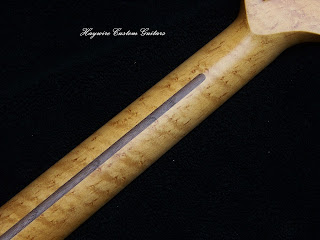
What Is Guitar Neck Profiling? How Custom Shaving Rescues Playability
When a guitar neck feels wrong, it changes your entire relationship with the instrument. You might find yourself uncomfortably stretching to clear complex chord shapes, feeling tension accumulate in the meat of your palm, or fighting hand fatigue halfway through a long set.
Many players assume that if a neck feels bulky, they simply have to suffer through the factory-standard dimensions or swap out the entire guitar. Others frequently confuse a neck’s overall thickness (the measurement from the front of the fretboard to the back of the wood) with its profile (the actual shape of the contour, such as a C, V, or U profile).
If your fretboard feels like a block of wood rather than a fast, comfortable surface, understanding your profile is the first step toward reclaiming your playing speed.
The Difference Between Thickness and Profile
To evaluate how an instrument fits your hands, it helps to isolate these two distinct structural characteristics:
- Neck Thickness: This is a strict depth measurement taken at the 1st and 12th frets. Two different guitars can have the exact same thickness numbers on paper but feel completely different in your hand because of how the wood curves.
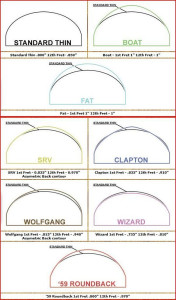
- Neck Profile: This is the cross-section shape of the back of the neck. For example, a vintage “U-shape” chunkier neck has high, blocky shoulders that fill out the palm, whereas a modern “C-shape” features a gradual, rounded slope that leaves more breathing room for your thumb to pivot.
-

Standard neck profiles from Warmoth Guitar Products featured in many Haywire Custom Guitars
The Home Diagnostic Test: The Palm Tension Check
To determine if your current neck contour is actively working against your natural hand anatomy, run this straightforward physical check at your workbench:
- The Lower Register Test: Form a clean, multi-fret barre chord around the 3rd fret. Pay attention to your fretting thumb. Is it forced to flatten completely out or grip aggressively around the top edge to give your fingers enough clearance? If your hand feels strained here, your neck profile likely has too much wood in the “shoulders,” forcing a wide, unnatural hand span.
- The 12th Fret Pivot: Move up past the 9th and 12th frets and try a smooth string bend. Notice if the base of your thumb or the side of your palm starts hitting the heel contour early, breaking your finger angle. Bulky factory neck joints often choke your access to the upper register, limiting your reach where you need it most.
Where DIY Boundaries Stop and Master Craftsmanship Begins
Recognizing that an instrument is too thick or blocky is an excellent diagnostic breakthrough. However, modifying a guitar’s structural wood is a point of no return.
Shaving down a neck to a fast, slim profile or replicating a favorite vintage contour requires an expert hand. A luthier must precisely calculate the internal architecture of the wood—ensuring that carving down the back profile never breaches the internal truss rod channel or compromises the overall neck stability under full string tension. The process demands meticulous, microscopic adjustments and constant checking to guarantee the new shape tapers flawlessly and symmetrically from the nut down to the heel block.
While we keep our custom contouring jigs, sand-grit progressions, and proprietary finish-blending workflows strictly under lock and key, we make sure the final result feels like a natural extension of your hands.
You don’t have to stay stuck wrestling a bulky factory profile. Our specialized Guitar Neck Shaving, Thinning, and Re-Profiling services are designed to reshape heavy, uncomfortable necks into sleeker, lightning-fast contours contoured precisely to your hands. Let’s make your favorite guitar play the way it was truly meant to.
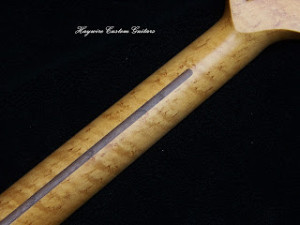
A shaved roasted maple guitar neck at Haywire Custom Guitars can make a huge difference in feel.

Leave A Comment
You must be logged in to post a comment.