

What to Expect During a Professional 8-Point Guitar Tune-Up.
When a guitar is brand new or fresh from the factory it may not have had any adjustments done. As a rule, a guitar should be set up when first purchased (used or new) and again when switching string gauges. Consider getting a set up anytime the guitar sounds or feels different than it used to. Perhaps after a guitar travels (altitude changes, pressure changes, and humidity can affect the wood in the guitar) and just like changing oil in a car it is a good idea to get a set up every now and then for maintenance purposes (perhaps twice a year).
A professional 8-point guitar tune-up maximizes your instrument’s playability, tone, and structural health. This comprehensive service addresses every critical intersection of the guitar to eliminate string buzz, fix tuning instability, and make the instrument feel effortless to play.
- The Action: The technician inspects the straightness of the neck and measures the “neck relief” (the slight forward bow required for strings to vibrate freely).
- The Goal: Using precise adjustments, the truss rod is adjusted to eliminate back-bowing or excessive curvature. This provides a perfectly flat, stable foundation for low action without fret buzz
- The Action: The machine heads (tuners) are thoroughly checked for slippage, backlash, or mechanical wear.
- The Goal: Loose hardware is tightened, and the internal gears are lubricated. This removes friction, smooths out the tuning experience, and prevents the strings from slipping out of pitch while playing. [1, 2, 3, 4]
- The Action: Every single fret is evaluated for uneven wear, sharp edges (“fret sprout”), or pits caused by heavy playing.
- The Goal: High spots are precisely leveled down, re-crowned, and polished until they are completely smooth. This eliminates choked notes during string bends and ensures buzz-free performance across the entire fret-board.
- The Action: The strings pass through the nut slots, which act as a critical point of friction. The tech measures the slot depth and angles. [1, 2, 3]
- The Goal: Slots are meticulously filed to the correct depth and lubricated (often with graphite or dedicated nut sauce). This stops strings from binding or making “pinging” noises when tuning, heavily boosting tuning stability. [1, 2, 3]
- The Action: Potentiometers (volume/tone knobs), pickup selectors, and input jacks are checked for oxidation and loose connections.
- The Goal: Components are sprayed with specialized cleaners like DeoxIT to clear out dust, eliminating static crackle. Input jacks are reinforced with structural washers to prevent spinning, and internal wires are securely routed and grounded. [1, 2, 3, 4, 5]
- The Action: The fret-board has a specific horizontal curve, known as the radius. The bridge saddles must be individually adjusted to mirror this exact curvature. [1, 2]
- The Goal: Matching the string radius perfectly to the neck contour ensures consistent finger pressure and a balanced string-to-string feel across all positions. [1, 2]
-
- The Action: The overall distance between the bottom of the strings and the top of the frets is dialed in at the bridge and saddles.
- The Goal: The height is customized to your preferred playing style (e.g., lower for fast, light picking or slightly higher for heavy strumming and slide play). This makes fretting chords require minimal physical effort. [1, 2, 3, 4, 5, 6]
- The Action: Using highly sensitive strobe tuners, the tech compares the pitch of an open string with the note played at the 12th fret. The saddle positions are physically moved forward or backward to compensate for string tension. [1, 2, 3, 4]
- The Goal: This step ensures the guitar stays perfectly in tune with itself as you play higher up the neck, preventing sour-sounding open chords and solos. [1, 2, 3]
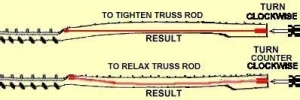
How a guitar truss rod works in the guitar neck.
When a guitar is set up properly:
- A guitar will feel and sound its best
- The strings will sound with exactly the notes they are supposed to
- Notes will sound correct when played at each fret up and down the neck
- The guitar will be as easy to play
- Strings will break less frequently.
If a guitar plays easily and sounds its best then it’s easy for the player to feel successful.
When a guitar is not set up properly:
- A guitar may not feel or sound quite right
- Some notes may sound correct while some others may sound sharp or flat
- The guitar may be difficult to play
- Strings will break more often

wrong guitar strings hurt fingers-guitarist-fingers-guitar hard to play and guitar action too high


Leave A Comment
You must be logged in to post a comment.