



Haywire Custom Shop
8 Point Tune Up For Your Guitar
Has your guitar become a little difficult to play sometimes? Strings too tight? Strings high off the fret board in the middle? Does it sound, “out of tune”? Are the strings too high off the neck everywhere? Is the neck warped, humped or bowed? Are the tuning gears difficult to turn due to rusty moving parts? Are the frets scratchy and rough when you try and bend notes? Are the fret ends sharp? Maybe, your guitar needs an 8-Point tune up!
A hard to play guitar could be a roadblock to your success as a musician, so if you want your guitar to play better and faster, let Haywire prep your guitar with our ” 8 Point Gig Ready Process”.
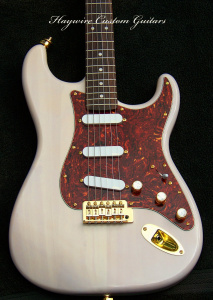
Welcome To Haywire Custom Guitars. High performance guitars without the high price. Get Soaring highs, clear, mellow mids and deep lows.
Our 8-Point Performance Check
- Point 1: 4-Way Truss Rod & Relief Calibration
- The Symptom: Annoying string buzz on the lower frets, high action down the neck, or seasonal neck bowing.
- The Relief: We dial in the exact neck straightness required for your preferred string gauge, creating an effortless, low-action feel without fret rattle.
- Point 2: Precision Nut Slot Dressing & Radius Matching
- The Symptom: Tuning slips every time you bend a string, or that annoying “ping” noise when tuning up.
- The Relief: Slots are precisely cut, spaced, and polished to match your fretboard’s exact curve. Strings glide smoothly, locking your guitar into pitch all night.
- Point 3: Bridge & Saddle Radius Equalization
- The Symptom: Individual strings feel uneven across your fingers, making your solos feel clumsy or mismatched.
- The Relief: We match the individual saddle heights perfectly to your fretboard’s unique radius so every string responds with uniform tension and height.
- Point 4: Harmonic Intonation Micro-Adjustments
- The Symptom: Chords sound perfectly in tune at the 3rd fret but sour and dissonant when playing up past the 12th fret.
- The Relief: Precise compensation at the saddle ensures your guitar stays perfectly in tune across every single square inch of the fretboard.
- Point 5: Fret Leveling & Crown Inspection
- The Symptom: Notes “choke out” or die completely during wide string bends on certain areas of the neck.
- The Relief: We identify high spots and ensure a completely level playing surface for smooth, uninterrupted vibrato and bends.
- Point 6: Pickup Height & Output Balancing
- The Symptom: Your neck pickup booms and overpowers your amplifier, while switching to the bridge pickup sounds thin and quiet.
- The Relief: Pickups are balanced symmetrically relative to magnetic pull and string vibration, ensuring smooth, consistent volume transitions when switching positions.
- Point 7: Electronics De-Ox & Clean Sweep
- The Symptom: Crackling, popping, or unexpected volume drops when adjusting your pots or using the selector switch.
- The Relief: Complete flushing and cleaning of all contacts, switches, and jacks to guarantee dead-silent, completely reliable performance under hot stage lights.
- Point 8: Structural Hardware Torque & Anchoring
- The Symptom: Loose input jacks, rattling tuners, or a strap button spinning loosely in stripped wood.
- The Relief: A complete top-to-bottom security pass. Every tuner casing, control nut, and strap lock is anchored securely so nothing vibrates loose mid-show.
Haywire Guitar tune up Gig-
Turn the guitar you have into the guitar you play. “We’re musicians working for musicians.” Let us work for you!

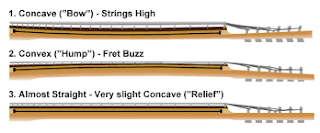
Haywire Custom Guitars guitar truss rod action setups
What Really Happens During a Professional Guitar Setup?
A guitar setup is often described as if it’s a simple matter of adjusting the truss rod, lowering the strings and setting the intonation.
That’s not how we see it at Haywire Custom Guitars.
A properly set-up guitar is an instrument in which the neck, frets, nut, bridge, strings, electronics and hardware are all working together—and working the way you need them to work.
Every guitar is different. Every player is different. Some players like higher action. Others want their strings as low as possible. Some play aggressively and need more room. Others have a lighter touch and want an exceptionally fast, low-playing instrument.
Our job is to find that balance.
At Haywire, we approach a guitar setup as a complete inspection and adjustment of the instrument—not simply a few quick turns of a screwdriver.
Here are the eight major areas we concentrate on when setting up a guitar.
1. Four-Axis Alignment of the Guitar Neck
Everything starts with the neck.
Before adjusting string height or intonation, we check the neck carefully for proper alignment and straightness.
We look at the neck in four directions—right, left, back and forward—and then make sure it is properly centered in relation to the guitar.
Why does that matter?
Because the neck is the foundation on which everything else is built.
A neck that isn’t properly aligned can contribute to poor playability, inconsistent action and unnecessary fret buzz. It can also make it difficult to achieve the playing characteristics the player wants.
We want the neck properly aligned before we start chasing the smaller adjustments.
2. Tuning Machines: Tight, Smooth and Working Properly
A guitar can’t stay in tune if the hardware responsible for holding the strings isn’t doing its job.
We inspect the tuning machines, check for looseness or excessive play, and make sure each mechanism is operating properly.
Where appropriate, the tuning gears are lubricated for smooth, consistent operation.
We also look at the other places where the strings encounter friction.
Why?
Because tuning stability isn’t just about the tuning machines.
The entire string path matters.
A string that binds at the nut or another contact point can make accurate tuning frustrating, even when the tuning machine itself is perfectly good.
3. Pickup Inspection, Potting and Pole-Piece Adjustment
Your pickups aren’t simply something we ignore while working on the mechanical parts of the guitar.
If the pickups have not already been properly potted, we can wax-pot them to help reduce unwanted microphonic squeal and feedback.
We also adjust the pickup pole pieces to follow the curvature of the neck and strings.
The goal is a balanced relationship between the pickup and the strings so the instrument responds properly across the fret board.
It’s another example of why we look at the guitar as a complete system rather than a collection of unrelated parts.
4. Preparing and Inspecting the Guitar’s Electronics
When working on the guitar’s electronics, we pay attention to the details that can make the difference between an instrument that works properly and one that develops problems later.
Wiring is inspected and routed carefully.
Connections and grounds are checked.
Controls and potentiometers are tested to make sure they operate properly.
We don’t want you discovering a wiring problem halfway through a gig.
A good setup should leave you with confidence in the instrument—not another problem to worry about.
5. Leveling and Polishing the Frets
Now we get to one of the most important parts of guitar play-ability:
the frets.
Even a very good guitar can develop uneven frets through normal playing, wear, manufacturing variations or previous work.
Uneven frets can create buzzing, dead spots and limitations when trying to achieve low action.
We inspect the fretwork and, when necessary, level and polish the frets so they provide a more consistent playing surface.
If a player wants extremely low action, this becomes particularly important.
You can’t simply keep lowering the strings and expect good results if the frets underneath them aren’t properly level.
6. Matching the Strings to the Neck Radius
Look closely at your guitar neck and you’ll notice that it isn’t perfectly flat across its width.
It has a contour called the neck radius.
The strings need to follow that same general contour.
We adjust the individual string heights so that the strings properly follow the radius of the fretboard.
This is one of those adjustments that may seem small—but it has a significant effect on how the guitar feels underneath your fingers.
The objective is to create a consistent playing surface across all six strings.
7. Setting the Action—and Adjusting the Nut and Bridge
Now we get to the adjustment most guitar players notice immediately:
string height, or action.
But there isn’t one “correct” action for every guitar player.
Your ideal action depends on how you play.
A player who attacks the strings hard may need more clearance. A player with a lighter touch may prefer very low action.
That’s why we don’t simply set every guitar to the same measurement.
We adjust the instrument to the player’s needs.
During this stage, we also inspect and adjust the nut and bridge when necessary.
The objective is simple:
Make the guitar comfortable to play while maintaining the performance characteristics the player needs.
8. Setting the Guitar’s Intonation
Finally, we set the intonation.
This is what helps the guitar play in tune as you move up the fretboard.
But at Haywire, we’re not satisfied with simply making an adjustment and immediately handing the guitar back.
We set the intonation twice.
After the first setup, we allow approximately 24 hours for the guitar to settle into its new adjustments. We then recheck and reset the intonation.
Why?
Because a guitar is under considerable tension from the strings. When significant adjustments are made, the instrument can move and settle as it finds its new balance.
Giving the guitar time to seat in allows us to come back and make the final corrections.
That’s an important part of our approach.
The Result: A Guitar That Feels Like Your Guitar
When all eight areas have been addressed, the goal isn’t simply to have a guitar that measures correctly on a workbench.
The goal is to have a guitar that feels right in your hands.
It should be comfortable.
It should stay in tune.
It should play cleanly.
It should respond properly.
It should be capable of the action you want.
And most importantly, it should work for the way you play.
That’s what we mean when we say Gig-Ready.
A properly set-up guitar shouldn’t feel like a different instrument.
It should feel like your instrument—only better.
Why We Don’t Call This a “Quick Setup”
There’s a reason our approach involves considerably more than adjusting a truss rod and lowering the bridge.
A guitar is a chain of interconnected components.
Change one thing and it can affect something else.
Lower the action and the fretwork becomes more important.
Change the neck relief and the action changes.
Change the action and intonation may need attention.
Change strings and the instrument can respond differently.
That’s why we work through the guitar systematically.
We aren’t simply adjusting parts. We’re bringing the entire instrument into balance.
And that’s ultimately what a professional guitar setup should accomplish.
How Much Does a Haywire Guitar Setup Cost?
Complete Haywire Guitar Setup: $85
For that investment, our goal is to give you much more than a guitar that is simply “adjusted.”
We want you to leave with an instrument that is comfortable, properly adjusted, playing cleanly and ready to go to work.
Whether you’re playing at home, rehearsing with your band, recording in the studio or heading out for a gig, your guitar should be something you can depend on.
Musicians working for musicians.
Haywire Custom Guitars Inc.
Conway, South Carolina
843-347-5742
Thanks for letting us work for you.

Worldwide Guitar repair, Instrument Repairs, Maintenance and Modifications. Send us your broken and needy instruments for quick reliable repairs.